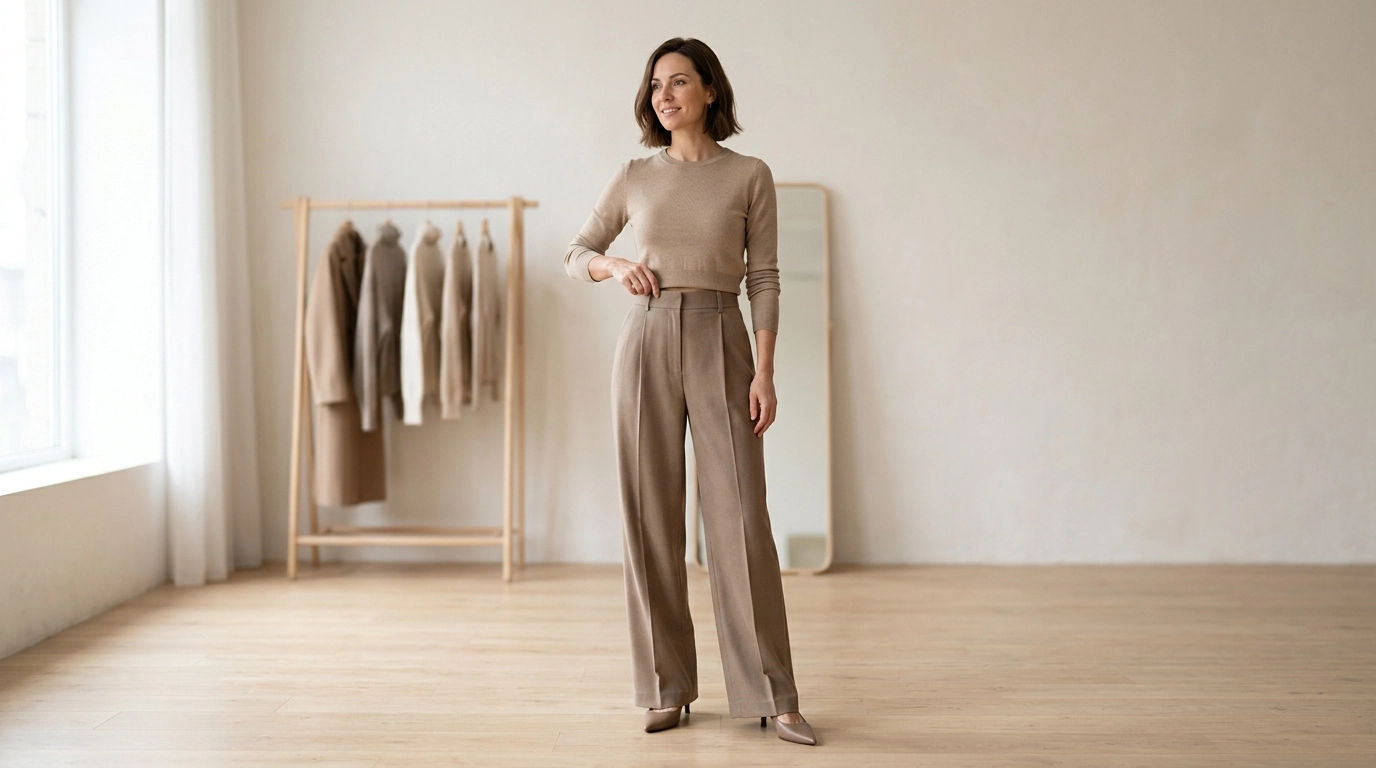
A longer-looking leg line is less about height and more about where the eye is guided: the waist placement, uninterrupted vertical lines, and clean transitions between tops, bottoms, and shoes. With a few consistent style moves—rise, hem, color, and proportion—outfits can look instantly more balanced and leg-lengthening without relying on uncomfortable trends.
The eye reads the body in segments. Strong horizontal breaks—like a top that ends at the widest part of the hips, a sharp color change at the waist, bulky cuffs, or a thick ankle strap—visually “cut” the leg line shorter.
One of the fastest ways to change proportion is to raise the visual waist. When the waistline sits higher (or is styled to look higher), the legs appear to start higher on the body, which lengthens the lower half.
Vertical continuity does the rest. Matching shoe-to-pant (or shoe-to-leg) tones, clean front lines, and minimal bunching keep the gaze moving up and down instead of stopping at the ankle.
Proportion is the shortcut: a slightly cropped top paired with a high-rise bottom often lengthens legs more than a long top that covers the hips, even if both outfits use the same pants.
Mid- to high-rise bottoms lift the visual waist and give the leg more “real estate.” If low-rise is the vibe, balance it with a tucked, cropped, or waist-defined top to keep the leg-to-torso ratio from skewing short.
Hems tend to flatter most when they do one of two things: fully cover the ankle (long trousers) or clearly expose it (cropped above the ankle bone). Awkward in-between lengths can truncate the line, especially when paired with bulky shoes.
Straight seams, center creases, long layers worn open, and V-necks all build vertical pathways. The goal isn’t to look “tall,” but to look uninterrupted.
High contrast at the hip (dark bottom, light top) or ankle (black shoe with bare legs) can segment the body. Tonal dressing—similar shades across top, bottom, and shoes—is one of the quickest ways to make legs look longer.
If a repeatable system would help, The Illusion of Longer Legs with the Right Clothes – Style Guide eBook organizes rises, hems, proportions, and shoe pairings into plug-and-play outfit formulas.
| If the outfit feels shortening… | Swap to… | Why it helps |
|---|---|---|
| Top covers the hips and cuts the leg line | A tuck, half-tuck, or waist-length top | Raises the visual waist and lengthens the lower half |
| Pants stop at a bulky ankle break | Full-length hem or a clean ankle-baring crop | Avoids the “stump” effect at the ankle |
| Shoes contrast sharply with legs or pants | Nude-to-you, tonal, or pant-matching shoes | Extends the vertical line through the foot |
| Skirt sits low on the hips | High-waist A-line or wrap skirt | Makes legs look like they start higher |
| Layering looks boxy | Long open layer + defined waist underneath | Adds vertical lines while keeping proportion |
A simple accessory can also help “lift” the eye upward. A softly shimmering scarf worn long and loose creates a gentle vertical line; the Gold Glitter Scarf is an easy add-on for cooler days.
For a step-by-step system (including plug-and-play combinations), The Illusion of Longer Legs with the Right Clothes – Style Guide eBook turns leg-lengthening principles into quick outfit formulas and straightforward rules you can apply to what’s already in the closet.
For deeper fashion study and design fundamentals, explore programs and resources from Parsons School of Design and the Fashion Institute of Technology (FIT).
Usually, because they raise the visual waist. The effect is strongest with a tucked or shorter top and a hem that doesn’t bunch at the ankle.
Low-vamp flats with pointed or almond toes tend to lengthen the line. Keeping shoes close to your skin tone or matching your pants also reduces contrast that can shorten the look.
Either full-length pants that nearly skim the floor or a clean crop that clearly shows the ankle bone. Mid-calf lengths and bunchy ankle breaks often make legs appear shorter.





Leave a comment