
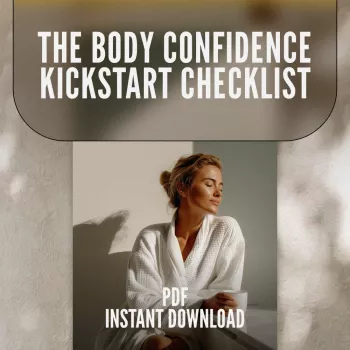
Body confidence often improves faster with small, repeatable actions than with big promises. The Body Confidence Kickstart Checklist is designed to make that momentum easy: quick daily steps that support a steadier mindset, kinder self-talk, and choices that feel aligned with real life. Instead of waiting to “feel confident” before living your day, this approach helps you build confidence through doable behaviors—especially on the mornings when motivation is nowhere to be found.
Body confidence isn’t a switch—you don’t flip it once and keep it forever. It’s more like a rhythm you return to. This checklist is built for that return.
For deeper context on body image and mental health support, the American Psychological Association’s overview of body image is a helpful starting point.
The goal isn’t to become a brand-new person in seven days. The goal is to lower friction so your “next supportive step” is always obvious—even when your brain is trying to pull you into comparison or criticism.
| Where it lives | Best for | Simple tip |
|---|---|---|
| Printed copy | Morning and evening routines | Tape it inside a closet door or next to skincare |
| Notes app | On-the-go check-ins | Pin it to the top and use checkboxes |
| Planner / journal | Reflection and habit tracking | Add a 1–2 line daily note about what helped |
| Wallpaper screenshot | Constant gentle reminders | Use a cropped version with only the daily essentials |
If you want a ready-to-use version, The Body Confidence Kickstart Checklist is an easy, low-pressure starting point—simple enough to repeat, flexible enough to personalize.
This rhythm is meant to feel realistic: a few minutes per day, focused on the moments that tend to trigger the biggest spirals (getting dressed, mirrors, social media, social plans).
| Day | Focus | Time needed | What to write down |
|---|---|---|---|
| 1 | Comfort-first outfit | 5–10 min | What felt easier when clothes didn’t pinch or distract |
| 2 | Mirror neutrality | 1–3 min | One neutral statement that felt believable |
| 3 | Feed cleanup | 5 min | One trigger removed, one supportive account added |
| 4 | Mood movement | 10 min | Before/after mood rating (0–10) |
| 5 | Gentle nourishment | 5 min | One addition that improved energy or steadiness |
| 6 | Boundary | 2 min | Exact words used (or a script for next time) |
| 7 | Weekly reset | 10 min | Top 1–2 wins and the next tiny tweak |
For movement ideas that support mood and health without turning into punishment, the CDC’s overview of physical activity benefits can help reinforce the “why” behind the tiniest steps.
| Moment | What it can trigger | Fast response |
|---|---|---|
| Getting dressed | Avoidance, outfit spirals | Choose the “first comfortable option” and stop at good-enough |
| Seeing photos | Zooming in, shame | Look at the whole scene; name 2 non-body details you like |
| Social events | Self-monitoring, comparison | Focus on a role (host, listener, friend) instead of appearance |
| Mirror checks | Judgment loops | Use one neutral sentence; then redirect to a next action |
| Tight clothing days | Irritability, self-criticism | Swap to comfort immediately; treat it as data, not a verdict |
If clothing is a frequent trigger, add one “confidence accessory” that feels like you. A small style anchor—like the Gold Glitter Scarf—can make outfits feel more intentional without forcing you into uncomfortable pieces.
If body image struggles are tied to eating distress or obsessive behaviors, the National Eating Disorders Association’s body image resources can be a supportive next step alongside daily habits.
If you want something straightforward to follow without overthinking, start with The Body Confidence Kickstart Checklist and commit to the “minimum version” on the hardest days. That’s often where the biggest trust gets built.
Many people notice small shifts within a week, like fewer spirals and easier mornings. More stable confidence typically builds over several weeks as the steps become automatic and familiar.
Use the minimum version rule and choose 1–2 supportive actions (comfort-first clothing and a neutral statement are a strong combo). Keep inputs simple by reducing comparison triggers and focusing on basics like hydration, meals, and rest.
No—this is centered on body respect, self-talk, and daily habits that support confidence without requiring weight-focused goals. If you have health concerns, professional guidance can help you choose appropriate support.






Leave a comment