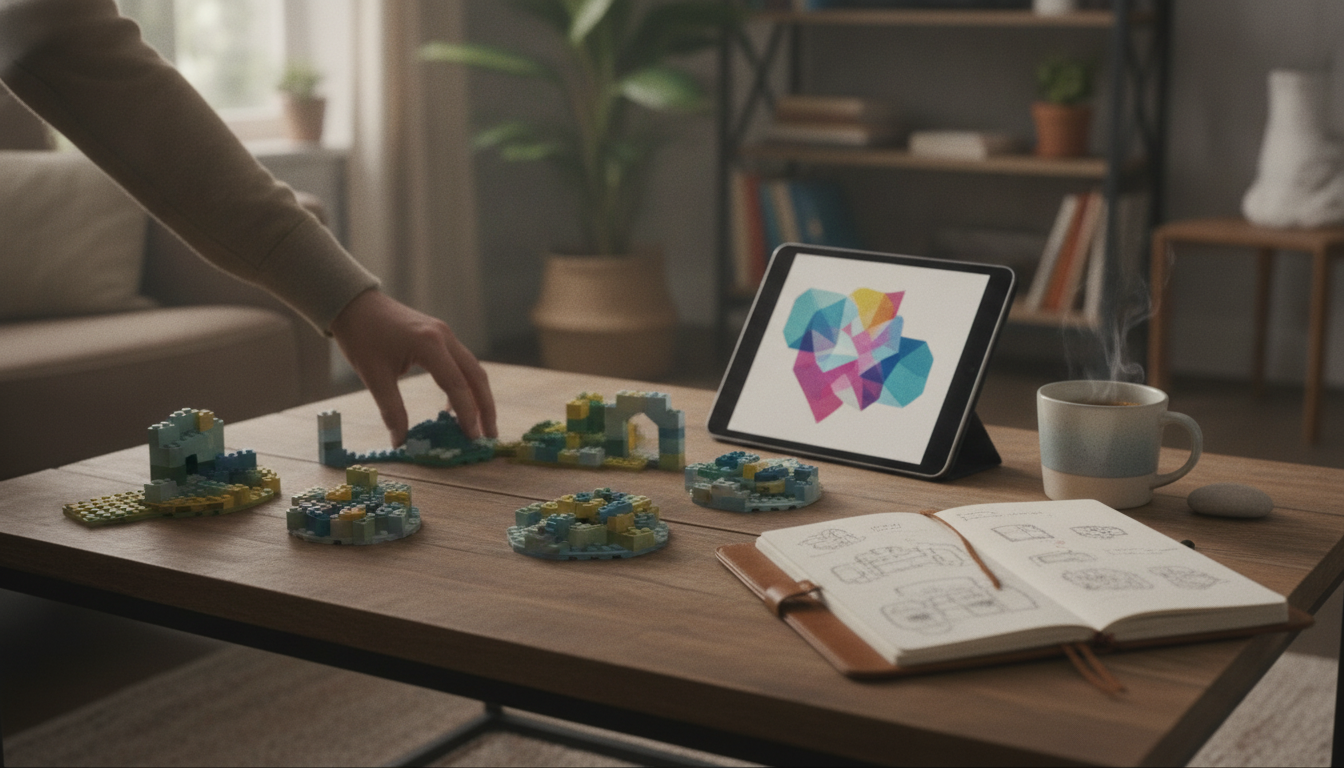
LEGO building can function as a calm, screen-light ritual that blends hands-on focus with creative expression. Having a ready set of ideas makes it easier to start (and easier to stop) because you’re choosing a mood, not inventing a plan from scratch. Below are mindful, architectural, artistic, and “AI-style” constraint challenges you can use with whatever bricks you already own—plus a simple way to make your building space feel more relaxing in minutes.
For a broader library you can revisit week after week, the Creative LEGO® Building Ideas for Adults – Digital Guide compiles structured prompts that scale from quick resets to display-worthy projects.
Adult brick-building is a “hands-busy, mind-steady” activity: sorting, stacking, and patterning naturally slows your pace and gives your attention something gentle to hold. That doesn’t replace professional care, but it can complement everyday stress management habits recommended by organizations like the American Psychological Association.
A soothing setup is less about a perfect organization system and more about reducing friction. Aim for “easy to begin” and “easy to pause.”
If you like adding a cozy cue to your routine, a soft accessory such as the Gold Glitter Scarf can double as a “start building” signal—wrap it around your chair or keep it nearby as part of the ritual.
Architectural builds are ideal for adults because they reward restraint: clean lines, repeated motifs, and carefully chosen details. Many can be done in compact footprints, making them easy to finish.
Build an 8–12-stud-wide storefront and focus on one feature: windows, arches, cornices, or door framing. Repeat the study in two palettes to see how color changes the “era.”
Create an inner garden using tiles as pathways and slopes as landscaping. Aim for balance and negative space—leave room for the eye to rest.
Limit yourself to rectangles and right angles. Explore rhythm with repeating protrusions and setbacks, like a simple skyline.
Design three roof types (gable, flat, stepped) using the same footprint. Compare silhouette, stability, and how shadows fall across each shape.
Build in stackable “floors” so the project can expand over time without a restart. This keeps momentum high and makes stopping points obvious.
Art-focused builds trade “accuracy” for feeling. The goal is to explore color harmony, texture, and form without pressure to match a reference.
These challenges mimic the fun of generated constraints while keeping your hands on the bricks. Odd limitations reduce perfectionism because the goal becomes “solve the puzzle,” not “make it flawless.” (For more adult-focused inspiration, LEGO’s own Adults Welcome hub highlights how broad the hobby can be.)
| Challenge | Time | Constraint | What to focus on |
|---|---|---|---|
| Monochrome Mood | 15–30 min | Use one color + neutrals only | Shape language and silhouette |
| Three-Part Story | 30–45 min | Build 3 small scenes that connect | Narrative clarity |
| Found Object Sculpture | 20–40 min | Start from one unusual piece | Transforming the “seed” piece |
| Architect’s Cutaway | 45–60 min | Expose an interior on one side | Spatial planning and proportions |
| Texture Quilt | 20–30 min | Divide a plate into 6–9 panels | Surface variety and repetition |
A repeatable framework makes the hobby easier to return to—especially when you don’t have the energy to plan. The Creative LEGO® Building Ideas for Adults – Digital Guide pulls architectural studies, artistic explorations, “AI-style” constraints, and structured challenges into one place.
Yes. The ideas scale from simple to complex, so you can start with quick, calming builds and add constraints only when you want more challenge.
No. Most projects can be built with common bricks and plates, and you can swap colors, substitute parts, or build at a smaller scale when your collection is limited.
Use 10–20 minute formats like a reset build, a symmetry build, or a slow-build breathing rule. Stop at a natural checkpoint rather than chasing a perfect finish.





Leave a comment